Whisper
OpenAI / openai.com
OpenAI's open source speech recognition model with broad language support and strong accuracy, widely used in applications and self-hosted deployments.
Pricing
Free
Free plan
Yes
Category
Audio
Platforms
4
Free plan
Yes
API access
Yes
Open source
Yes
Platforms
4
What is Whisper?
Whisper is OpenAI's open source automatic speech recognition (ASR) model, released in September 2022, and it quickly established itself as one of the most capable and widely deployed speech recognition systems available. Its combination of strong accuracy, broad language support, and open source availability has made it a foundational component in many AI applications, transcription services, and developer projects.
The model was trained on 680,000 hours of multilingual audio from the internet, which produced exceptional breadth across languages, accents, and audio conditions. Whisper handles accented speech, background noise, and technical vocabulary significantly better than many specialised commercial transcription services, particularly for languages outside the major Western European group.
Whisper comes in multiple model sizes: tiny, base, small, medium, large, and the more recent turbo variants. Smaller models run faster on consumer hardware with lower accuracy; larger models produce better transcription at higher computational cost. The large-v3 model is the most accurate and is used in most production applications where quality matters.
For developers, Whisper represents a free, high-quality alternative to commercial speech APIs like Google Speech-to-Text or AWS Transcribe. Self-hosted deployment keeps audio data on the developer's own infrastructure without paying per-minute API fees, which is a significant cost advantage for high-volume transcription workloads.
Whisper is accessible through the OpenAI API at $0.006 per minute for users who do not want to manage their own deployment. Many third-party platforms including Groq (which runs Whisper at very high speed) and Replicate also provide hosted Whisper access.
Limitations include real-time performance, which is challenging with larger models, and word-level timestamps that require additional tooling on some model versions. For very low-latency real-time transcription, purpose-built streaming systems may perform better.
How Whisper works
Whisper runs as speech-to-text software built around audio and text workflows. Users typically start with a prompt, upload, or connected data source, and the underlying model handles the heavy lifting before returning a result you can refine or export. It's available on python, docker, and web (via third-party), with API access for teams that want to embed it into their own products.
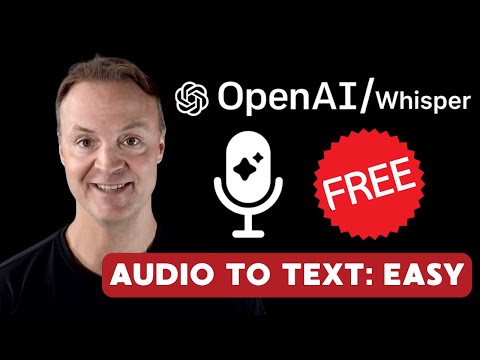
Watch Whisper in action
Recent YouTube videos cached from the backend so this page stays fast and fresh.


What makes it worth shortlisting
The capabilities that matter most for teams evaluating Whisper.
Multi-language transcription
Recognises and transcribes speech in 99 languages from audio files with strong robustness to accents and background noise.
Multiple model sizes
Choose from tiny to large model variants trading off speed and accuracy based on available hardware and use case requirements.
Translation to English
Can transcribe audio in another language and simultaneously translate to English, useful for multilingual content workflows.
Best use cases
Who should use it
Pros
- High-quality transcription in 99 languages with strong accent and noise robustness
- Open source with free model weights for self-hosted deployment
- Very cost-effective compared to commercial APIs at high volumes
- Multiple model sizes allow quality/speed trade-off based on hardware
Cons
- Real-time performance challenging for larger models
- Speaker diarisation requires additional tools and configuration
- Larger models need significant GPU for fast processing
- API version priced per-minute which adds up at scale
Is it worth the price?
Open source model weights free to download and self-host. Accessible via OpenAI API at $0.006/minute of audio. Available through many third-party platforms.
Model
Open Source
Starting price
Free
Free trial
No
Tools like Whisper
Otter.ai and Fathom provide consumer-friendly meeting transcription experiences. Rev.ai provides enterprise transcription API with strong accuracy and HIPAA support. Google Speech-to-Text and AWS Transcribe are competing commercial APIs.
Whisper vs Rev.ai
A side-by-side look at the closest alternative in this category.
Whisper
OpenAI
Rev.ai
Rev.com
Open source model weights free to download and self-host. Accessible via OpenAI API at $0.006/minute of audio. Available through many third-party platforms.
Free trial with 300 minutes of transcription. Usage-based at $0.02/minute for async transcription. $0.021/minute for streaming. Custom enterprise pricing.
Self-hosted: complete data privacy with no cloud upload. OpenAI API: review OpenAI's data handling policy for audio files. Third-party hosting: review each provider's terms.
Enterprise includes HIPAA Business Associate Agreements. SOC 2 Type II certified. GDPR compliant.
Self-hosted Whisper keeps all audio on your own infrastructure. OpenAI API processes audio through OpenAI's servers. Review privacy settings if using for sensitive recordings.
Review Rev.ai's data handling policy. Audio submitted for transcription is processed by Rev.ai's infrastructure. Enterprise includes BAA for HIPAA compliance.
- High-quality transcription in 99 languages with strong accent and noise robustness
- Open source with free model weights for self-hosted deployment
- Very cost-effective compared to commercial APIs at high volumes
- Multiple model sizes allow quality/speed trade-off based on hardware
- Strong transcription accuracy for English
- Reliable speaker diarisation for multi-speaker recordings
- Simple API integration with async and streaming support
- HIPAA-eligible for healthcare applications
- Real-time performance challenging for larger models
- Speaker diarisation requires additional tools and configuration
- Larger models need significant GPU for fast processing
- API version priced per-minute which adds up at scale
- Developer-only product with no consumer interface
- Less suitable for consumer meeting note-taking use cases
- Multi-language coverage weaker than some competitors
- Custom model training requires Enterprise plan
Technical & deployment info
Key facts about model providers, platforms, and team support.
Model Provider
OpenAI
Models
Whisper large-v3, Whisper turbo, Whisper small
Platforms
Python, Docker, Web (via third-party), API
Deployment
Open Source, SaaS (OpenAI API)
Integrations
Groq (fast inference), Replicate, Hugging Face, OpenAI API
Team Collaboration
No
Launch Year
2022
Security & privacy
Compliance signals and data-handling notes as reported by the vendor.
Self-hosted: complete data privacy with no cloud upload. OpenAI API: review OpenAI's data handling policy for audio files. Third-party hosting: review each provider's terms.
Self-hosted Whisper keeps all audio on your own infrastructure. OpenAI API processes audio through OpenAI's servers. Review privacy settings if using for sensitive recordings.
What users are saying
Verified reviews from signed-in users, stored in the backend and averaged into this tool's rating.
Sign in to rate Whisper and leave a review.
No other reviews yet — be the first to share how this tool performs in practice.
Common questions about Whisper
Editorial Verdict
Should you use Whisper?
Whisper is the best choice for developers who need high-quality multilingual transcription and want open source flexibility or cost-effective API access. For consumer meeting transcription, Otter.ai and Fathom provide better user experiences.
Last verified July 24, 2026.